Latham Drywall Questions, Sorted by Room and Season
Here are the wall and ceiling questions Latham homeowners tend to raise, grouped so you can jump straight to the room or season in front of you. Every answer is brief, and every group points to the page with the full repair.
Winter and the ceiling
Why do rings show up after a mild spell rather than during the storm?
Ice dams form when snow melts from beneath and refreezes at the eaves. Leaking starts with the following thaw, as melt pools behind that ridge.
Does a dried ring still matter?
It stays put and can spread during the next melt. Once the roof issue is solved and a meter confirms dryness, it gets sealed with shellac-type primer and recoated.
What comes first if the ceiling is drooping?
Shut off the circuit powering lights or fans mounted nearby on that ceiling, empty the room beneath it, and position a bucket below the lowest spot.
The full repair is on the ice-dam ceiling page.
Cracks in walls and ceilings
Why do cracks begin at door corners?
An opening's corner is the weakest spot in a wall, so framing movement shows there before anywhere else.
Why does the gap atop my wall shut every summer?
That is truss uplift. Roof trusses arch upward in a frigid attic and drop back once it warms.
Will caulk do?
Caulk masks a crack briefly. Reopening it, retaping and feathering it broad holds up far longer.
The full repair is on crack repair in Latham.
Garages and basements
Does a garage wall need special board?
Model codes want gypsum board on the garage face of a wall shared with the house and Type X board on a garage ceiling below living space, so repairs follow suit.
Why is basement drywall crumbling at floor level?
Board resting on the slab can soak up moisture. The repair removes the spoiled strip and leaves a slim gap above the floor.
The full repair is on repairs for garage and basement walls.
Outside corners and trim
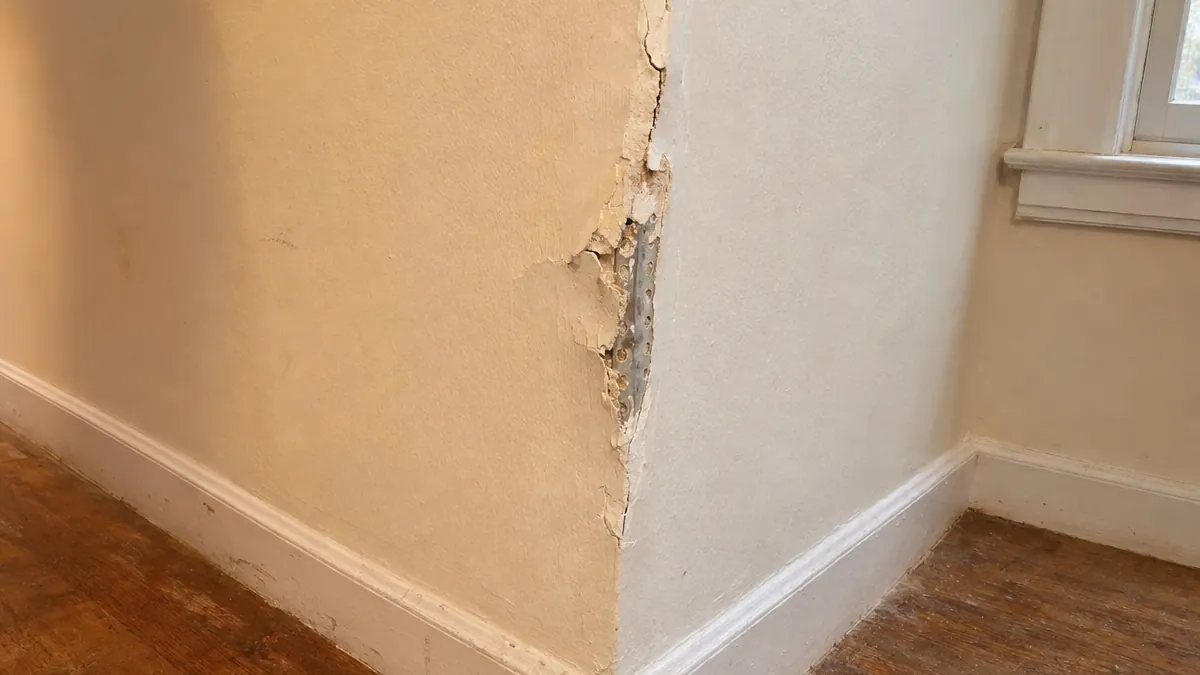
What is the metal peeking out of my wall corner?
Corner bead, the metal or vinyl strip that shapes an outside corner. When mud flakes off it, the bead shows; a kinked bead gets cut out and renewed.
Does a chipped corner always need new bead?
Not if the bead is straight and still snug to the wall. Loose mud is scraped away and the corner is rebuilt in two or three passes.
The full repair is on patching dents, holes and corners.
Scheduling and the room
How many visits should I expect?
Two for most modest patches; three or four when a leak ruined part of a ceiling. Each layer of mud needs its own drying window.
Can I use the room in between?
Yes, provided the patch is left untouched. Cold, humid rooms slow drying, so winter jobs can run a day longer.
Where does the sanding powder go?
Sanding makes most of it. Sheeted floors, shut vents and a vacuum sander keep it close to the repair.
The order of a repair day is laid out on the homepage.
Costs
What does a small patch run?
This Old House put a contractor's small-hole patch at about $60 to $200 in its June 2026 pricing article. Treat it as nationwide context rather than local pricing.
Why might one quote be higher than another?
Size, height, texture, water damage needing removal, and how many drying visits are required.
To get a number for your own wall, describe the damage on the quote form.